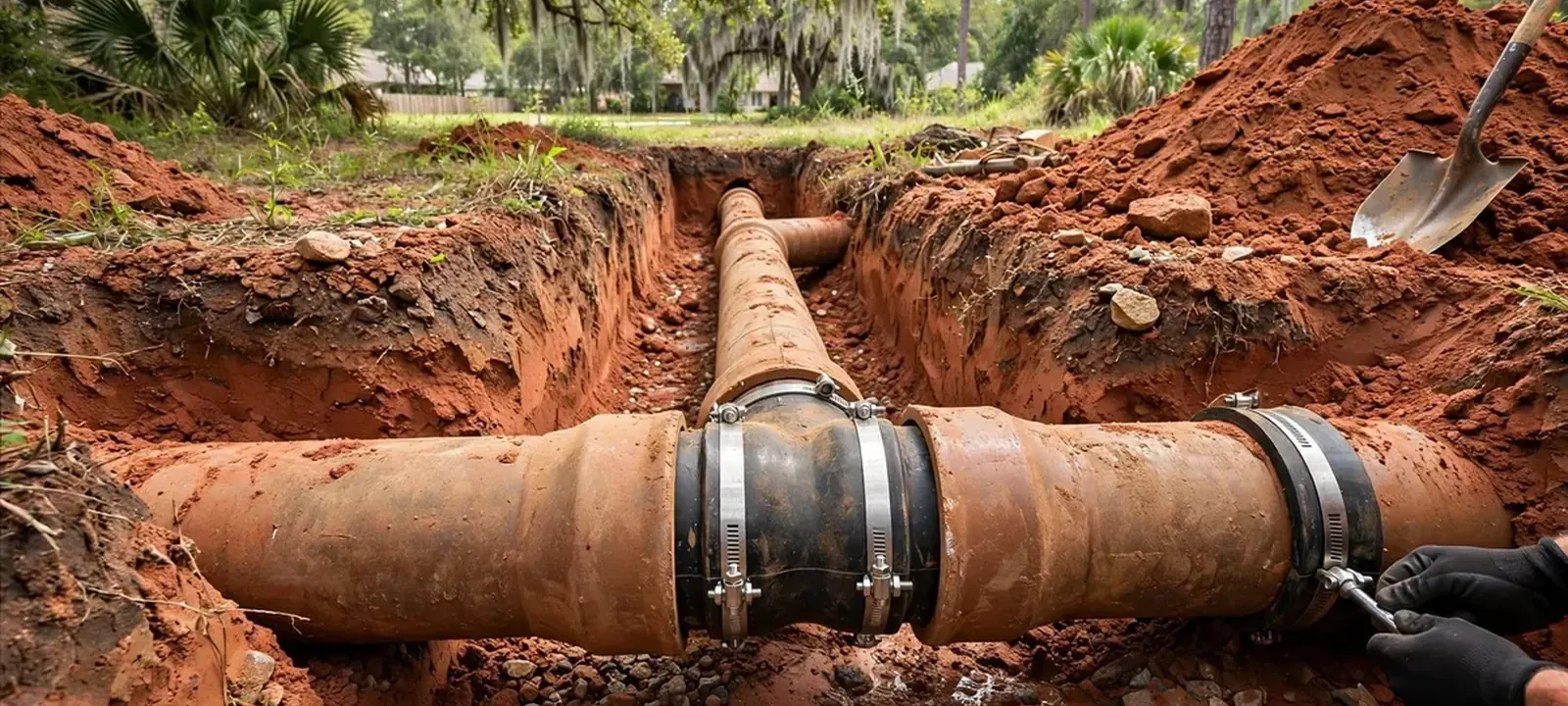
Sewer line repair, from first camera to finished pipe
Sewage coming up a floor drain is an emergency. Our 24/7 dispatch handles emergency sewer line repair in Eagle Mountain, UT, and your first job is to stop using water and keep everyone away from the wet area.
Sewer line repair is the fixing or replacing of the pipe that carries wastewater from your house to the city sewer or a septic tank. Fixes range from a short spot repair to a full replacement, and a camera decides which one fits. We explain each option and give you a clear price before work starts.
Sewage is backing up into the house: what to do first
Sewer backup is the most common reason people call us for this work. A night call goes straight to dispatch, and a same-day slot opens up whenever the schedule allows.
Until the plumber arrives, protect the home and the people in it.
- Stop all water use, including washers, dishwashers and showers. Every gallon has to go somewhere.
- Do not flush any toilet, even if the bowl looks fine.
- Keep children and pets away from the wet area. We do not diagnose health effects, so treat sewage water as unsafe.
- Do not mix or pour cleaning chemicals. Mixed cleaners can release harmful fumes.
- Cut power to wet outlets and appliances only if the breaker panel is dry and easy to reach.
- Take photos of the backup and the damage for your insurer before cleanup starts.
Sewage in the house?
Call (385) 488-1892 and ask for a same-day appointment when one is available.
What a sewer backup is telling you
A failing line gives hints first. These signs often appear weeks before a full backup, and many begin as a plain blockage that main sewer cleaning can open.
Several drains slow together
A tub, a toilet and a sink all draining poorly point at the main, not a single fixture.
Gurgling after a flush
Air pushed back through a trap means the sewer line is partly blocked.
The lowest drain backs up
Sewage finds the lowest opening first, such as a basement floor drain or a bathtub on the lowest level.
Sewage smell outside or downstairs
A broken pipe leaks gas and wastewater into the ground, and the smell follows.
A wet or sunken patch in the yard
A soft spot or a dip in the lawn over the line can mark a leak or a collapse.
Clogs that keep returning
Repeat clogs after cleaning point at a sag, an offset joint or roots inside the pipe.
Symptom, likely break and repair path
The camera confirms the cause. This table shows the usual match between what you see and what we fix.
| What you see | Likely cause | Typical repair path |
|---|---|---|
| A backup that returns after cleaning | A belly (sag) or an offset joint | Spot repair or section replacement |
| Roots found at one joint | An open joint or a crack | Cut the roots, then line or repair the joint |
| Several cracks along one stretch | Damaged pipe or poor bedding | Pipe lining or pipe bursting |
| A collapsed or crushed section | Ground shift or heavy load | Excavate and replace that section |
| Sewage at the yard surface | A break or a separated fitting | Locate, excavate and repair |
Dig and replace, or go trenchless?
Open trench replacement
- Installs new pipe along the old path
- Fixes collapsed and badly sagging sections
- Can correct a wrong slope
- Opens up lawn, driveway or patio on the line
Trenchless lining or bursting
- Works through small access pits or the cleanout
- Leaves most of the yard in place
- Needs a pipe that is not collapsed or badly offset
- Narrows the pipe bore slightly
Trenchless sewer repair and pipe lining explained
Pipe lining, often called cured-in-place pipe, pushes a resin-soaked liner into the old pipe and cures it into a smooth new inner pipe. It seals cracks and open joints and blocks root entry. The old pipe must be cleaned first, often by hydro jetting, and a camera must confirm that the run is continuous.
Pipe bursting pulls a new pipe along the old path while breaking the old one outward. It suits a line that has sagged or cracked in many places but still follows the right route. Both methods need only small access points.
Epoxy lining and lateral replacement are other names you will hear for these two paths. Neither fits every pipe, and we tell you when an open trench is the honest answer. The city's permit sheet lists sewer connections and drain-waste-vent work, so check with the city before work begins.
From first camera run to a finished repair
Clear and camera
We clear the line enough to pass a camera, then record the whole run from the cleanout to the street connection.
Locate and mark
A locator tracks the camera head, so we know the depth and position of the break. We call 811 before any dig so buried utilities are marked.
Choose the method
We show you the video and explain the options: spot repair, lining, bursting or trench replacement, with the clear price before work starts.
Repair and prove it
After the work we run water and the camera through again, so you see the finished pipe on video.
Septic or city sewer? Confirm before you spend
Not every lot has the same wastewater setup. We do not assume which one your Eagle Mountain lot uses, so confirm with the city or county whether it connects to a public sewer or to a septic tank.
A septic system has a tank and a drain field, and a backup can start there instead of in the pipe from the house. Tank pumping and drain field work usually fall to septic contractors and follow their own rules. If a camera shows your house line is fine, we say so and point you to the right trade.
On city sewer, who owns which stretch of pipe near the street varies. Ask the city before you hire anyone for work close to the property line.
Why a sagging sewer pipe keeps clogging
Gravity moves sewage, so the pipe must slope steadily downhill, commonly about one quarter inch per foot for smaller drain lines. A belly is a low spot where the pipe settled, often from poor bedding or ground that shifted after construction. Water pools there, solids drop out, and the clog returns however often you clean.
Plumbing code sets minimum slopes by pipe size. A camera shows standing water at the belly, and a spot repair restores the fall. Lining a sagging pipe keeps the sag, so we do not offer lining as a fix for a deep belly.
Sewer line repair across Eagle Mountain
With the city built out mostly since the late 1990s, your sewer lateral is probably newer plastic pipe. Trouble here tends to come from poor bedding, a joint pulled apart, ground that settled, or roots, not from rusted iron.
A younger line often has a fixable spot rather than a whole failed pipe. That is where spot repair or lining pays off.
Saratoga Springs sits roughly 10 miles away along Pony Express Parkway (an estimate), and our Saratoga Springs page covers that side. In both places, call 811 (Blue Stakes of Utah) before any dig so buried lines are marked.
What moves the price of a sewer repair
A sewer repair can be a short spot fix or a full replacement, so the camera result sets the scope before any number is firm.
Coverage for sewer lines varies a lot. Some policies cover sudden backup damage, some cover the pipe, and many cover neither, so ask your agent. Work on sewer connections and drain-waste-vent piping may need a permit, so ask the Eagle Mountain Building Department at 801-789-6614.
Want your real number? Call (385) 488-1892 and get the clear price before any digging starts.
Checks to make before you hire for sewer work
Sewer work is costly to redo, so a few checks pay off with any contractor. Look up any plumber's license with the state's Verify a License lookup before you sign.
- Ask to see the camera video of the break, not just a spoken description.
- Ask which repair methods fit your pipe and why the others do not.
- Confirm who pulls the permit and who calls 811.
- Get the clear price in writing before work starts.
- Ask how the lawn, driveway or patio will be restored.
- Ask for a camera run after the repair.
- Confirm with the city or county whether your lot is on sewer or septic.
Questions about sewer line repair in Eagle Mountain
Do you handle sewer line repair emergencies at night or on weekends in Eagle Mountain?
Yes. Dispatch never closes, and a same-day appointment can be booked if one is open. If sewage is coming up inside the house, stop water use, keep people out of the area, and call (385) 488-1892.
Is my sewer problem a repair or only a cleaning job?
Cleaning fixes a blockage. Repair fixes a broken, sagging or root-invaded pipe. If cleaning helps for only a few weeks, a camera usually finds a break or a belly. Our sewer inspection page explains the camera run.
Can the sewer line be repaired without digging up my yard?
Often, yes. Lining and bursting work through small access points. They do not suit a collapsed pipe or a deep belly, so the camera result decides, and sometimes the honest answer is an open trench.
Is the problem my sewer line or the city's sewer main?
If only your house backs up, the problem is usually in your line. If neighbors report the same thing, the public main may be involved. Then the city should hear about it, because the main belongs to the utility.
Do you work on septic systems?
A septic tank and drain field follow their own rules, and pumping and drain field work usually go to septic contractors. We can camera the house line to show whether the trouble sits in the pipe or the tank. First confirm with the city or county which system your lot uses.
Will a sewer line repair need a permit?
Often, yes. The city's permit sheet lists sewer connections and drain-waste-vent systems, though minor repairs can be exempt. Permit rules vary, so ask the Eagle Mountain Building Department at 801-789-6614.
Does homeowner's insurance cover a sewage backup?
Sometimes, through a sewer backup endorsement. Read your policy or ask your agent, and take photos before cleanup begins.
Where the rules come from
Utah plumbers work to the International Plumbing Code as the state adopts it, and each city decides how its permits apply. Before a job that touches supply piping, drains, gas or a water heater, confirm the permit question with the people who enforce it.