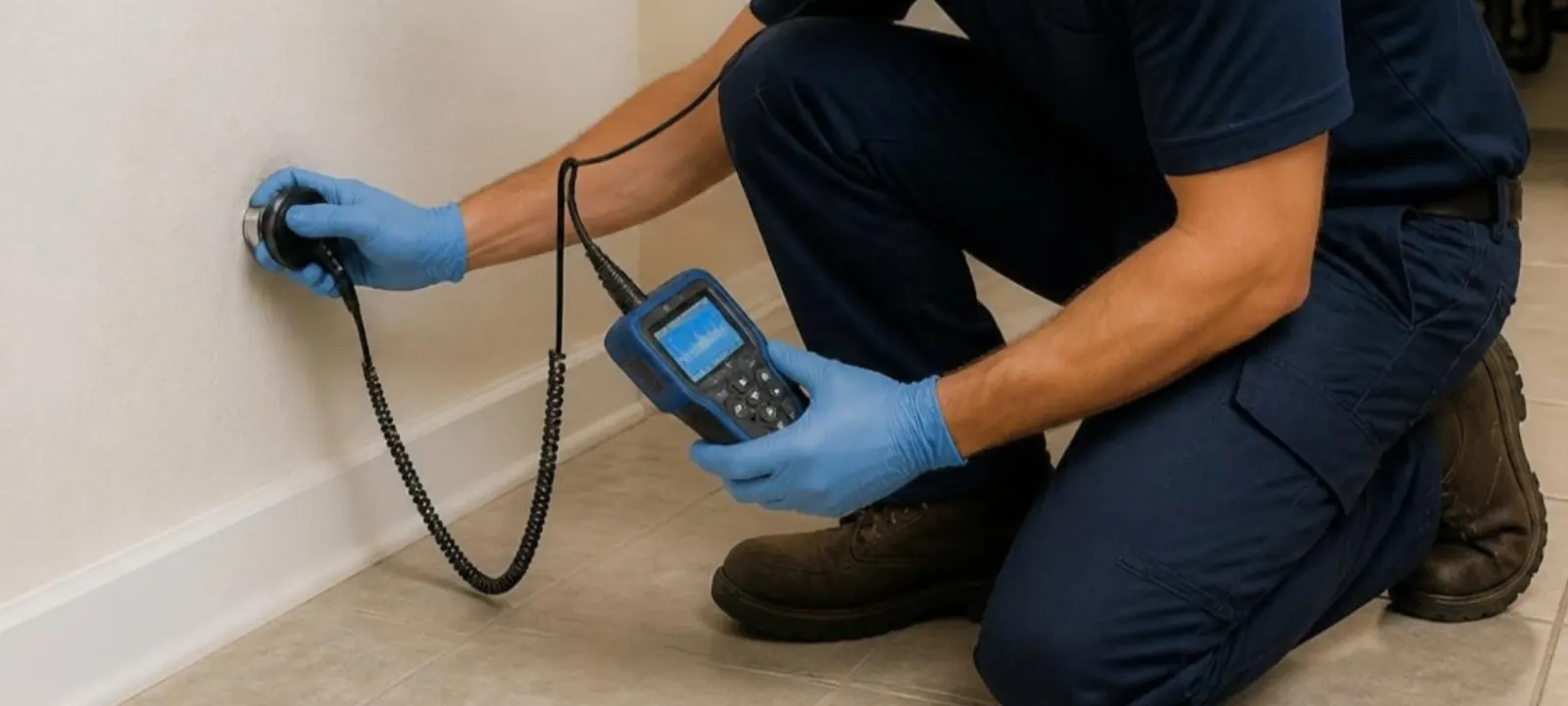
Hidden water leaks found without tearing the house apart
Emergency leak detection in Eagle Mountain, UT is urgent work because a hidden leak keeps running while you decide what to do. Our dispatch line is open 24/7, and while you wait you can shut the main valve and stop using water.
Leak detection is the process of locating a water leak you cannot see, using meter readings, pressure tests, listening gear and moisture tracing so only the failed spot gets opened. The aim is a small, accurate opening instead of a guess.
When a hidden leak cannot wait until morning
Water coming through a ceiling, a hissing floor, a wet wall or a meter that spins with every tap closed all deserve a night call. Dispatch is 24/7, and an after-hours visit still starts with a clear price before work starts.
- Close the main shutoff valve, usually where the supply line enters the house, by turning it clockwise until it stops.
- Read the water meter and write the number down before you leave the house, so a later reading shows if water is still moving.
- If the leak is near the water heater, switch off its power or set the gas control to pilot.
- Keep clear of a sagging ceiling and move rugs and electronics out of the wet area.
- If water drips from a light fixture or outlet, stay away from the switch and call (385) 488-1892.
Water moving where it should not be?
Dispatch answers all night. Call (385) 488-1892 and we will talk through the shutoff first.
A bill that keeps climbing and no wet spot anywhere
Most people find a hidden leak by its symptom, not by a puddle. The plumbing name for the fix is leak detection, which means tracing a symptom back to one failed joint, pipe or valve.
Meter keeps moving
The small leak dial turns while every fixture is off, so water is leaving somewhere.
Bill jumped, habits did not
A silent toilet flapper or a cracked buried line can add up fast over one billing cycle.
Hissing or trickling at night
A pressurized pipe leaking inside a wall or slab is often loudest when the house is quiet.
Warm patch on the floor
A hot water line leaking under a slab can warm the concrete above it.
Musty smell, no visible water
Damp drywall or insulation holds moisture long after the drip stops being visible.
Pressure dropped for no reason
A weak shower with the main valve fully open can point to water escaping before it reaches the fixtures.
Meter still running with every fixture off, or a high water bill
Close every tap, stop the dishwasher and washer, and pause the ice maker. Then open the meter box lid and look at the leak indicator, a small triangle or dial. If it turns, water is moving somewhere in the lines past the meter.
Next, shut the main valve at the house and check again. A dial that stops means the leak is inside the house. A dial that keeps turning points to the buried line between the meter and your home.
Many high bills have a boring cause. A toilet flapper that seeps can waste a bathtub of water a day without a sound, and a sprinkler zone stuck on does the same outdoors. We check those first because they are quick to rule out.
Which symptom points to which kind of leak
Use this as a starting map. The real answer comes from testing, not guessing.
| What you notice | Likely source | How we confirm it |
|---|---|---|
| Meter turns, house valve closed | Buried line between meter and house | Pressure test and ground listening |
| Meter stops once house valve is closed | Leak inside the home | Section by section isolation |
| Stain grows only when a fixture runs | Drain or waste line above the ceiling | Run each fixture and watch the spot |
| Stain grows all the time | Pressurized supply pipe | Moisture meter and thermal camera |
| Warm or damp floor | Hot water line in or under the slab | Acoustic listening and tracing |
| Soggy turf, strong grass strip | Sprinkler lateral or service line | Valve isolation and pressure check |
Wet ceiling, stained drywall and leaks behind walls
A brown ring on a ceiling tells you where water landed, not where it started. Water runs along joists and pipes before it drips, so the source can sit several feet away. We use a moisture meter and a thermal camera to follow the damp path back to the wet pipe.
The first question is whether the stain grows while nobody uses water. If it grows only when the upstairs shower runs, the culprit is a drain or a shower pan. If it grows around the clock, a pressurized supply line is leaking.
In an attic, rule out a bath fan duct or air handler drain line that drips condensation. Those look like pipe leaks but need a different fix.
Under the house: crawlspace leaks and a straight answer for newer homes
Many newer homes sit on a slab or over a basement, so a true crawlspace is less common here than in older towns. If your home has one, look for wet insulation, dripping joints, dark soil or a musty smell near the floor.
If your home has no crawlspace, the same symptoms usually point to wall cavities, the slab or the basement ceiling. We will tell you which case applies to your house instead of selling you a crawlspace search you do not need.
Buried and yard leaks between the meter and the house
The service line runs underground from the meter to your home. A leak there may show as a soft lawn patch, a strip of greener grass, a wet foundation edge or a drop in pressure. Frozen ground and cold soil can hide the wet spot, so testing matters more than looking.
We isolate the line with a pressure test, then listen along its length to narrow the dig to a small area. Call 811 before any digging so buried utility lines are marked. If the fix is a line replacement, our water service line repair page explains the process.
Slab leaks: hot floors, odd sounds and your repair options
A slab leak is a leak in a pipe that runs under or inside a concrete floor. Common signs are a warm spot on the floor, the sound of running water with fixtures off, wet carpet edges and a bill that rises with no explanation.
Once the leak is located, you usually have three choices. Break the slab at that one point and patch the pipe, reroute the line overhead through walls or ceiling, or replace the failing run. When several spots leak, repiping can cost less than repeated patching, and we explain the trade-off before you decide.
Slab work is a major plumbing repair, so permit rules vary. Ask the Eagle Mountain Building Department what applies to your address.
Sprinklers, pool plumbing and the meter box
Irrigation leaks hide in valve boxes, at heads and along buried lateral lines. Watch for a zone that runs weak, a spot that stays soggy after the timer ends or a valve box full of water.
Pool and spa plumbing can lose water through pump fittings, skimmer lines and return lines. A simple bucket test separates evaporation from a leak. We handle the plumbing lines and fittings, while a cracked pool shell is work for a pool specialist.
Water standing in the meter box may be a leaking connection at the meter itself. Report that to the city Water Department as well as to us, since the utility decides who works on its own equipment.
How a leak search runs from first call to repair
Read the meter and close the valve
We confirm water is actually moving, then split the house from the buried line to see which side is losing it.
Pressure test sections
Hot lines, cold lines and branches are isolated and tested one at a time until one section loses pressure.
Pinpoint with sound and moisture
Listening gear, a moisture meter and a thermal camera mark the spot on the wall, floor or ground.
Quote, then open the smallest access
You get a clear price before work starts, then we cut or dig only where the leak sits and repair it.
Eagle Mountain water details that matter during a leak search
The Eagle Mountain City Water Department, at 1650 E. Stagecoach Run, supplies drinking water from five groundwater wells plus surface water from the Central Utah Water Conservancy District. If a leak looks like it starts at the meter, that is the office to notify.
Most homes here were built since the late 1990s, so pipe age is a smaller factor than in older towns. Failed fittings, pinholes and installation stress are more common causes, which is why we test before assuming anything.
We serve Eagle Mountain and nearby towns. That includes Saratoga Springs, reached along Pony Express Parkway, covered on our Saratoga Springs plumbing page.
What changes the price of finding and fixing a leak
Detection and repair are priced separately in practice, because the search is the same whether the pipe is easy or hard to reach. You hear a clear price before work starts, and we do not quote a number by phone for a problem nobody has seen yet.
Sudden leaks and slow seepage are often treated differently by insurers, so photograph the damage, keep receipts and ask your insurer before repairs. Permit rules vary, so ask the Eagle Mountain Building Department.
Want your real number? Call (385) 488-1892 and describe what you see.
What to note before the plumber arrives
A few minutes of notes can cut the search time. We start with facts instead of guesses.
- The meter reading and the time you wrote it down
- Whether the meter still turns with the house valve closed
- Where stains, soft spots or warm floors appear
- Whether the sound or stain changes when you run a fixture
- Your last two or three water bills
- Where the main shutoff valve is and whether it fully closes
Questions about leak detection in Eagle Mountain
Do you handle leak detection emergencies at night or on weekends in Eagle Mountain?
Yes. Dispatch runs 24/7, and same-day appointments are offered when available for leaks that can wait for daylight. For active water in a ceiling or a spinning meter, shut the main valve first and call (385) 488-1892.
How do I know if my meter shows a leak?
Turn off every fixture and appliance, then check the leak indicator on the meter. If it moves, water is running. Close the main valve at the house and look again to see whether the leak is inside the home or in the buried line.
My water bill is high but nothing looks wet. Is that leak detection or something else?
It is usually the same job. A high bill with no visible water is the classic sign of a silent toilet leak, a buried line leak or a sprinkler problem, and leak detection narrows it to one cause.
Will you have to cut holes in my walls?
Only at the spot where the leak is confirmed. Pressure tests and moisture tracing guide the opening, so the hole is small and in the right place.
How can I tell a slab leak from a leak in the walls?
Warm floor patches, running sounds with fixtures off and damp flooring edges point toward the slab. Stains on drywall that grow over time point toward walls. A pressure test separates the two.
Should I call my insurance company before repairs?
Yes, call before work begins when you can. Take photos, save the old bill and ask what your policy says about sudden damage and hidden seepage.
Is a leaking sprinkler line part of leak detection?
It can be. We test irrigation valves and lateral lines like any other pressurized pipe, and a pressure drop tells us whether the problem sits in the yard or in the house line. For ongoing line issues see burst pipe repair.
Where the rules come from
Utah plumbers work to the International Plumbing Code as the state adopts it, and each city decides how its permits apply. Before a job that touches supply piping, drains, gas or a water heater, confirm the permit question with the people who enforce it.