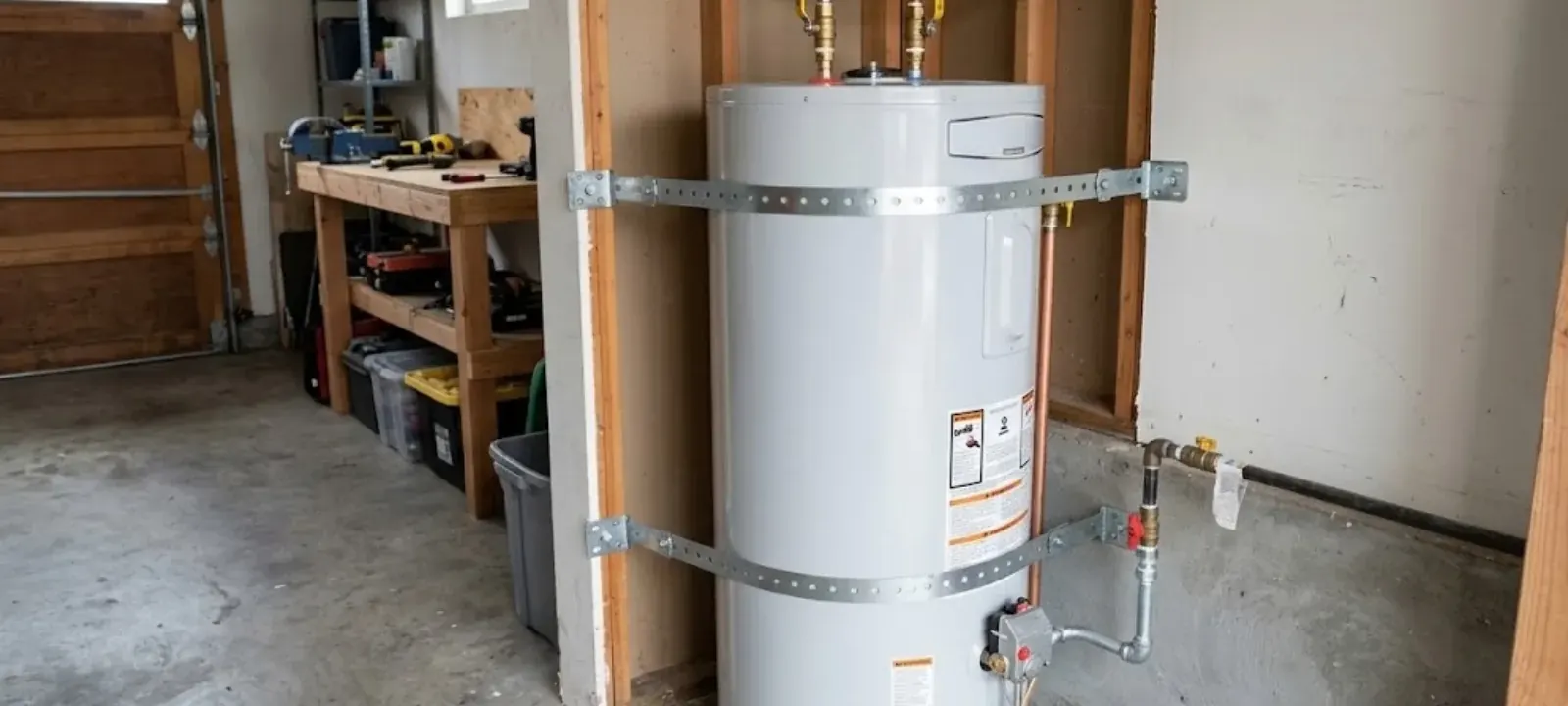
Water heater installation in Eagle Mountain, UT, done on your timeline
A planned water heater installation in Eagle Mountain, UT starts with a site visit to the room where the tank will live. We look at the gas line, the flue, the electrical panel, the drain, and the floor. That decides what can go in without rework.
Water heater installation means setting a new heater in a new or existing spot, then connecting water, fuel or power, venting, relief valve, and an expansion tank where the plumbing calls for one. Same-day visits for site checks are possible when openings exist.
Where the heater can go and what each spot demands
Location drives most of the extra work. Here are the usual choices for a house in Eagle Mountain. If the old tank is already failing, failed tank replacement covers the rushed version.
| Location | What it needs | Watch for |
|---|---|---|
| Garage corner | Drain pan, a raised base for gas units, and clearance from vehicles | Flammable vapors near a gas burner and bumper damage |
| Utility or mechanical room | A floor drain, combustion air, and a straight vent path | Tight rooms starving a gas heater of air |
| Basement | A sump or floor drain, a lift for the flue, and a drain pan | Basements that flood can drown a burner or element |
| Closet or alcove | A louvered door or ducting for combustion air, and a vent run | Heat buildup and a cramped relief valve discharge |
| Attic | A pan with a drain line to an approved point and a sturdy platform | A leak in a ceiling below, so pans and drain routes matter most |
Ready to book an install?
Tell dispatch at (385) 488-1892 what you are putting in and where.
Permits, inspections, and who to ask in Eagle Mountain
On the city's what-requires-a-permit sheet, water heaters sit with the plumbing work that needs a permit unless specifically exempted. Ordinary maintenance and many minor repairs can be exempt, but a new heater in a new spot is not ordinary maintenance. Because permit rules vary, ask the Eagle Mountain Building Department at 3267 E Campus Dr, Suite H, or 801-789-6614.
Utah adopts the International Plumbing Code with state amendments, and that code is what the inspector checks against. You can also confirm any plumber's license through the Verify a License lookup from the Utah Division of Professional Licensing.
Why a closed plumbing system needs an expansion tank
Water expands as it heats, and a tank full of hot water has nowhere to send the extra volume. When a check valve or pressure reducing valve closes the line, that pressure has no way back to the street. It lands on the relief valve, the tank, and every faucet in the house.
A small expansion tank with an air cushion absorbs the extra volume. It also protects the valves and connectors on a newer heater. We check your house pressure before we pick one.
Venting a new heater, from flue pipes to PVC runs
The vent is the part most often wrong on a rushed job. Each style has its own pipe, slope, and clearance rules, which follow the manufacturer's instructions and local code. A tankless unit adds its own demands, covered under tankless water heaters.
Natural draft flue
Hot exhaust rises through a metal vent to the roof. It needs slope, correct sizing, and enough room air.
Power vent
A fan pushes exhaust out through plastic pipe, so the run can go sideways through a wall. It needs a nearby outlet.
Direct vent
Sealed combustion draws outdoor air in and sends exhaust out, so it works in tight rooms.
Condensing models
Very efficient gas heaters cool exhaust so much that condensate forms, which needs PVC pipe and a drain.
Electric tank
No flue at all, only a dedicated circuit and a breaker sized for the elements.
Heat pump tank
No flue, but it needs open air space and a condensate drain, and it cools the room it sits in.
From the first call to a heater that passes inspection
Site visit and sizing
We measure the space, read your gas and electric service, and match capacity to how many people use hot water.
Clear price and schedule
You get the full scope in plain terms, including permit and venting items, and a clear price before work starts.
Install day
Old tank out if one exists, new heater leveled, water and fuel connected, relief valve and discharge pipe routed, expansion tank set.
Startup and walkthrough
We test combustion or elements, set temperature, check for leaks, and show you the shutoffs and the relief valve.
Questions to settle before you buy the heater
A few decisions are easier to make before the box is on your driveway.
- Which fuel will you use, and is the gas line sized for the new burner?
- Is there a floor drain or a safe route for a pan drain line?
- Does the room have enough air, and will the vent run be short and straight?
- Do you want an energy-saving heat pump model and the floor space it needs?
- Will the new heater fit through the doors and up any stairs?
- Who will pull the permit, and when should the inspection happen?
Installing in Eagle Mountain homes, from new builds to remodels
Most Eagle Mountain houses were built after the late 1990s, so you are more likely to find modern garage or basement mechanical spaces than cramped old closets. That makes relocating a heater to a better spot realistic during a remodel or a basement finish.
If you live in Cedar Pass Ranch, Harvest Haven, or Pole Canyon, confirm where the shutoffs sit before the install, because builders vary. Pony Express Parkway also carries us to homeowners in Saratoga Springs.
What changes the price of a water heater installation
Two houses with the same tank can get very different totals. These are the drivers.
Check with the Eagle Mountain Building Department on permits. Insurance rarely covers a planned upgrade.
Share your plans with dispatch at (385) 488-1892 and hear a real number before any work starts.
Questions about water heater installation in Eagle Mountain
Do I need a permit to install a water heater in Eagle Mountain?
Water heaters are on the city's permit list. Some like for like work can be exempt, and permit rules vary, so ask the Eagle Mountain Building Department at 801-789-6614. We work with the inspection when one is required.
Does a new water heater need an expansion tank?
If a check valve or pressure reducing valve makes your plumbing a closed system, an expansion tank is the standard fix. We read your pressure and decide on site.
Can the heater go in the attic or a closet?
Often yes, with a drain pan, a drain route, venting, and air. An attic leak has a long way to fall, so we are careful about those.
Can you convert from gas to electric during installation?
That depends on the panel and the available circuits. Gas to electric needs a dedicated 240 volt circuit. Electric to gas needs a gas line and a vent. We check both.
What does venting involve for a gas heater?
The vent must slope, stay the right size, and keep clear of combustibles. Power vent and direct vent models use plastic pipe through a wall, while natural draft units use a metal flue to the roof.
Can I install a tankless unit instead of a tank?
Yes, but the gas line, venting, and wiring often need upgrades. Read about tankless water heaters and ask for an assessment first.
What happens to the old water heater?
We drain it, disconnect it, and haul it out if you ask. If it is leaking or has failed, see water heater repair first to see if a part can save it.
Where the rules come from
Utah plumbers work to the International Plumbing Code as the state adopts it, and each city decides how its permits apply. Before a job that touches supply piping, drains, gas or a water heater, confirm the permit question with the people who enforce it.