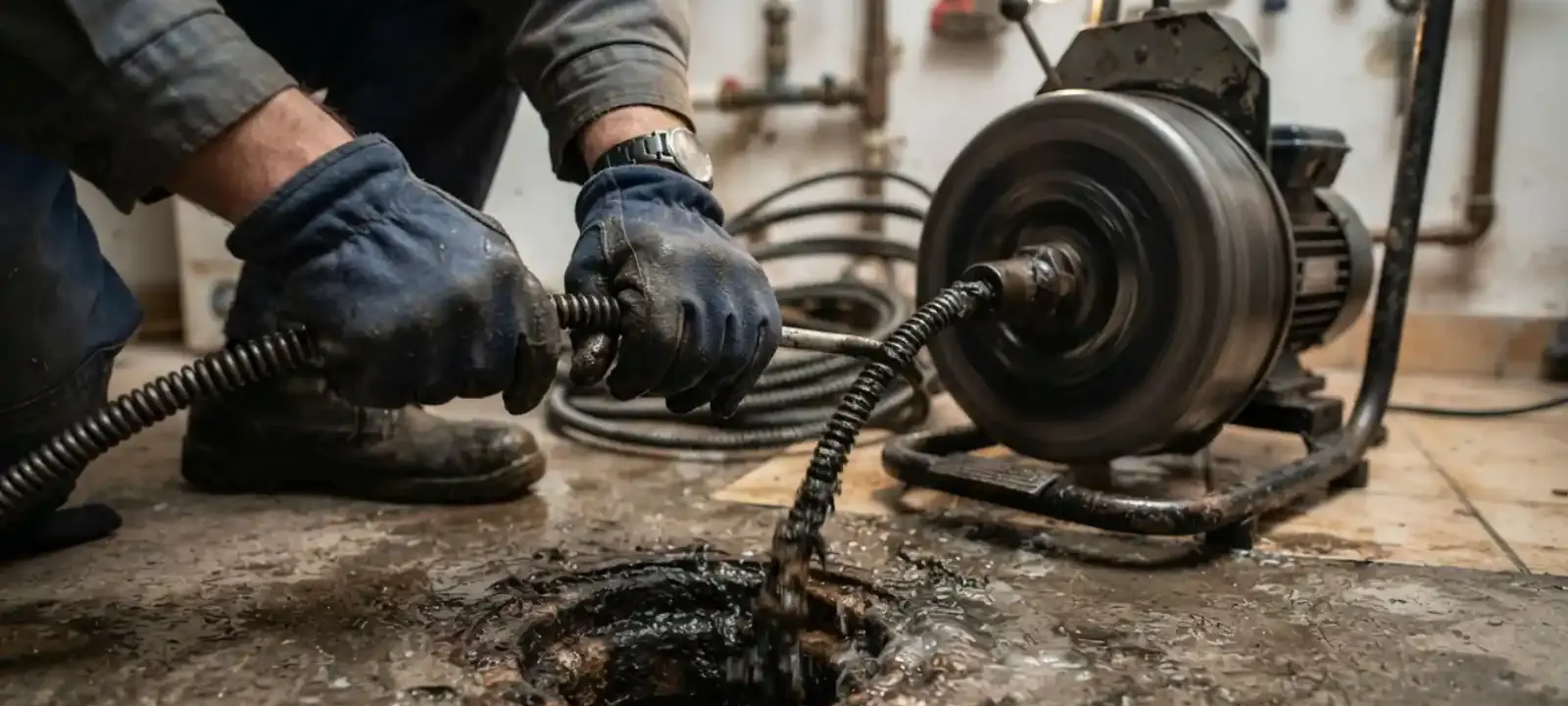
For a clogged sink or tub, a hand-crank drain snake with a quarter-inch cable usually reaches a clog in the trap or the first stretch of branch line. For a toilet, use a closet auger instead, since it has a protective sleeve for the porcelain. Feed the cable until it meets resistance, crank to hook the clog, and pull back slowly.
Stop when the cable will not advance, water backs up in other fixtures, or the same drain clogs again within weeks. Those signs mean the clog sits past what a hand tool can reach.
Which snake fits which drain
Tool choice decides most of the result. The wrong cable can scratch a fixture or stall at the first bend.
| Tool | Best for | Main limit |
|---|---|---|
| Hand-crank cable, quarter inch | Bathroom sinks, kitchen sinks, tub drains | Short reach and light pushing power |
| Closet auger | Toilet clogs near the bowl outlet | Not meant for any other drain |
| Drum auger, three-eighths inch | Longer branch lines and stubborn tub clogs | Heavier, and needs more care in tight traps |
| Plastic drain strip | Hair near the top of a sink or tub | Reaches only a few inches |
| Electric cable machine | Main lines and long runs | Calls for training, since a spinning cable can kink or injure |
Read the clog before you push anything down the pipe
A snake works only if it can reach the clog, so first decide where the clog is. If one fixture is slow and the rest are fine, the clog sits in that fixture's trap or branch. If every drain in the house is slow or gurgling, the problem is deeper and a hand snake will not reach it.
Pour a bucket of water down a nearby drain and listen. A toilet that bubbles when the washer drains points to a shared line. A single slow sink points to a local clog you may be able to snake yourself.
How to snake a sink or tub drain, one move at a time
Clear the work area
Take out the stopper or strainer, lay a towel under the sink, and put on gloves. Remove the trap first if you can, since a short path is easier to work.
Feed the cable slowly
Push the tip into the drain opening and extend a foot or two of cable. Tighten the thumbscrew near the housing so the cable holds.
Crank when you hit resistance
A bend or a clog stops the cable. Turn the handle clockwise to push through a bend, or to hook and break up a soft clog.
Pull back and clean the cable
Draw the cable out slowly, wiping it with a rag as hair and gunk comes up. Rushing can drag debris back into the drain.
Run hot tap water to test
Flush the drain for a minute and watch the flow. If it still stands or slows, repeat once, then stop and call a plumber.
Closet auger basics for a toilet that will not flush down
A closet auger is a short rod with a hooked tip inside a hard sleeve. Seat the sleeve in the bowl outlet, then crank the handle to feed the cable through the trap. The sleeve keeps the metal off the porcelain, which is why a long sink cable is the wrong choice here.
Stop if the cable meets a hard object that does not move. A child's toy or a wipe wad can jam in the trap, and pushing harder only packs it tighter. A toilet that backs up along with a tub points to a line problem beyond the auger's reach.
Want a plumber to look at it?
Call the 24/7 line and describe what you see. A licensed plumber can tell you the next step.
Eagle Mountain note: check your pipe before you crank
Eagle Mountain grew mostly after the late 1990s, so most homes were built in the last few decades. Look under your sink at the trap arm and the pipe going into the wall. White or black plastic pipe tolerates a smooth-tipped cable well, and a plumber can help if you cannot tell what you have.
If your snake leads you to dig for a cleanout in the yard, call 811 (Blue Stakes of Utah) before any digging. Buried lines can run across a lot in ways that are not obvious from the house.
Why a snake sometimes stalls at the first bend
A trap makes a tight U-turn, and a stiff cable can jam at that curve. Cranking harder only coils the cable and can scratch the pipe. Back out a few inches, rotate gently, and try again. If the cable still will not pass, removing the trap arm gives a straight shot into the wall.
Bathroom sink or kitchen sink: the cable behaves differently
Bathroom sink and tub
- Hair and soap are the usual clog.
- A pivot rod or stopper may block the opening.
- A plastic strip or hand snake often works.
- The trap is small, so go slowly.
Kitchen sink
- Grease and food are the usual clog.
- A garbage disposal can block the cable path.
- A drum auger may be needed past the trap.
- Cooled grease can coat the cable heavily.
Four ways people damage pipes or themselves with a snake
A snake looks simple, but force causes harm. These are the mistakes plumbers see most.
Forcing a stuck cable
Pulling hard on a jammed cable can tear the cable or break a plastic fitting. Rotate it back gently.
Using a closet auger on a sink
The curved shape and sleeve fit a toilet, not a sink trap. It can jam or scratch the fixture.
Running an electric machine in a small drain
A spinning cable can whip inside a short trap and hit a fixture. Leave powered tools for lines with a cleanout.
Snaking after pouring chemicals
Standing drain cleaner can splash up the cable. Wear goggles, or leave the job to a plumber.
Signs the snake is not the right tool
These signs mean the clog is too deep or too tough for a hand cable. Treat any one of them as a reason to put the tool down.
- The cable stops at a hard spot and will not hook anything.
- The clog clears but returns within a few weeks.
- Several drains slow down at the same time.
- Water backs up into a tub or floor drain when a toilet flushes.
- You pull up roots or gritty debris on the cable.
- The drain smells like sewage after you snake it.
What to expect when a plumber picks up the cable
A plumber reads the symptoms, chooses a cable size, and works from the cleanout or fixture. The goal is to clear the clog without scraping the pipe. Our drain cleaning service covers sinks, tubs, showers, and floor drains.
If the blockage is in the main line, the job calls for a bigger machine and often a camera. That falls under sewer line cleaning, since a hand snake cannot reach it.
We also work in nearby towns such as Saratoga Springs, where the same sink and tub clogs show up. Ask when you call about same-day appointments when available.
Questions readers ask
How far should I push a drain snake?
Feed it until it meets resistance, then crank to hook the clog. Most sink and tub clogs sit within a few feet of the opening. If the cable keeps going without resistance and the drain still stands, the clog is farther along.
Can a snake damage plastic pipe?
A smooth-tipped cable used with light pressure rarely harms PVC or ABS. Forcing a stiff cable around a tight bend can scratch or crack a fitting. Work slowly and stop if the cable binds.
Should I snake a toilet with a regular drain snake?
No, use a closet auger. Its curved head and protective sleeve are made to pass through the bowl without scratching the porcelain. A regular cable can scar the glaze.
Why does my drain clog again after I snake it?
A snake pokes a hole through the clog but may leave a film of grease and hair on the pipe wall. That film catches new debris. A water-jet cleaning can scour the wall, and a camera can show what is left.
Do I need to call 811 before snaking a drain in my Eagle Mountain yard?
Snaking through a cleanout is not digging, so no 811 call is needed for that. If the job turns out to need excavation, call 811 (Blue Stakes of Utah) before anyone breaks ground.
Where the rules come from
This guide is general information and does not replace the code. Utah adopts the International Plumbing Code with its own amendments, so use the links below to check a license and to see which jobs Eagle Mountain says need a permit.