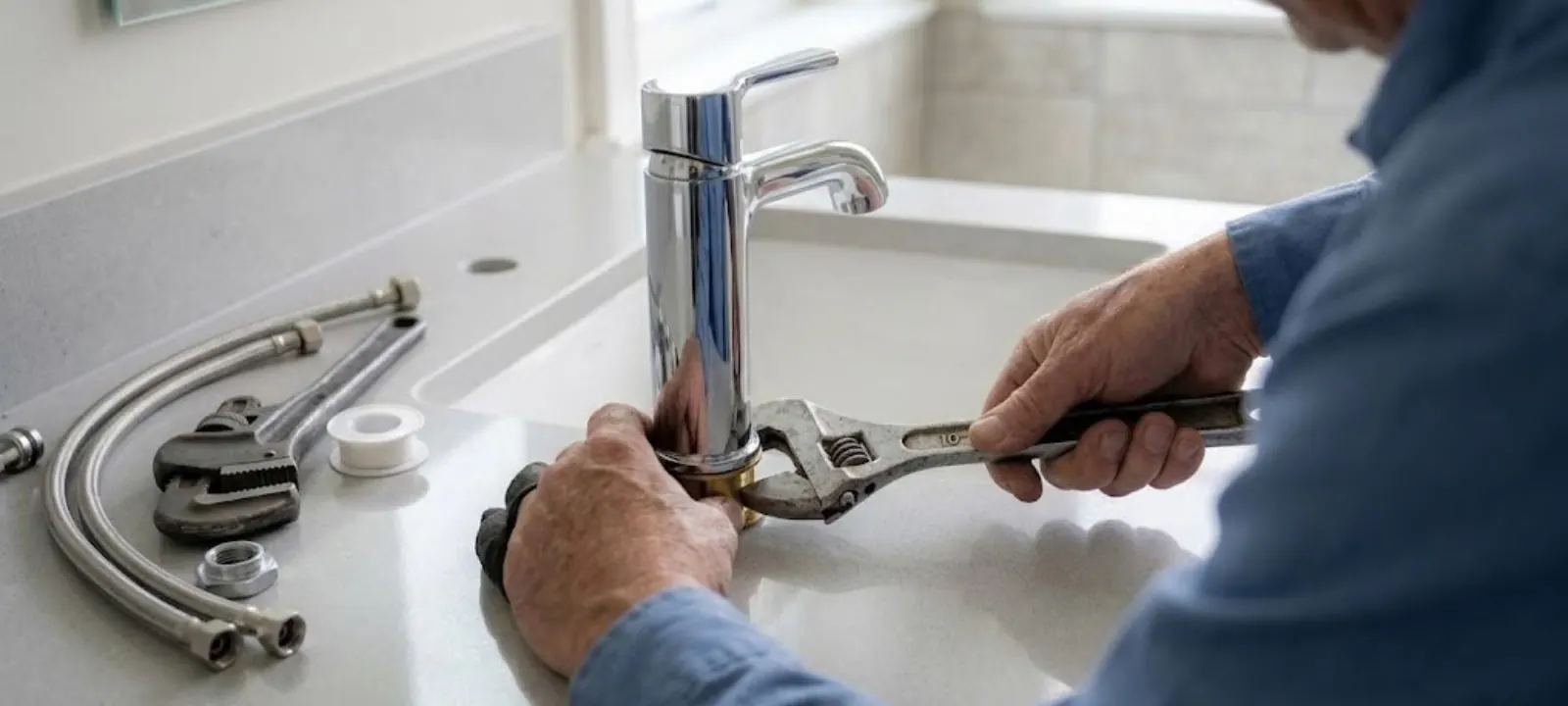
Most one-handle kitchen faucets leak because a cartridge, O-ring, or seat has worn out. The repair is to shut off both supplies, remove the handle, pull the cartridge, and install the exact matching parts. A drip from the spout usually points to the cartridge or seats, and a leak around the base usually points to the O-rings.
Photograph each step as you go so reassembly is easy. If the faucet body itself is cracked or corroded, replacement beats repair.
Find out which kind of one-handle faucet you own
A one-handle faucet hides one of three mixing designs inside the body. A cartridge faucet has a cylinder that slides and rotates. A ball faucet has a slotted metal or plastic ball with rubber seats and small springs. A ceramic disc faucet has a wide cylinder that holds two polished discs.
The type decides which parts you buy, so look before you shop. Remove the handle and compare what you see with photos on the maker's parts page, or take the old part to a plumbing counter. Matching by sight alone often fails because many cartridges look alike but differ by a few millimeters.
What the drip tells you about the worn part
Match your symptom to the likeliest cause before you open anything. This saves a trip for the wrong parts.
| What you see | Likely cause | Part to replace |
|---|---|---|
| Drip from the spout when the handle is off | Worn cartridge or tired seats and springs | Cartridge, or seats and springs for a ball type |
| Water seeping around the base of the spout | Dried or cut O-rings | Spout O-rings |
| Water around the handle when the faucet runs | Loose cap or worn cartridge top seal | Retighten, then cartridge if it persists |
| Handle feels stiff or gritty | Mineral buildup or dry cartridge | Clean and grease, or new cartridge |
| Low flow from the spout | Clogged aerator or cartridge ports | Soak aerator, then check cartridge |
| Water pooling inside the sink cabinet | Supply line or shutoff valve leak | Supply line or valve, not the faucet |
Tools and parts to set out before you shut off the water
Lay everything on a towel next to the sink. You will not want to hunt for a tool with the faucet in pieces.
- Small Allen key set and a Phillips screwdriver for the handle screw.
- Adjustable pliers or channel locks, wrapped in tape to protect the finish.
- A replacement cartridge or repair kit that matches your model.
- Spare O-rings and silicone-based plumber's grease.
- A cup or rag to plug the drain so no small part falls in.
- A flashlight to see the shutoff valves under the sink.
- A phone to photograph each layer before you remove it.
Six steps from a dripping spout to a dry faucet
Close the supply valves and relieve pressure
Turn both shutoff valves under the sink clockwise. Open the faucet to drain the lines, then leave it open while you work.
Plug the drain and remove the handle
Hide a rag in the drain. Pry off the small cap on the handle, remove the set screw with the Allen key, and lift the handle straight up.
Take off the cap and collar
Unscrew the decorative cap or the adjusting ring by hand or with taped pliers. On a ball faucet, lift off the cam and the rubber seals.
Pull the cartridge or the ball
Remove any retaining clip first, then grip the stem and pull it straight out. Rock it gently if it sticks, and never pry on the brass body.
Replace the parts and grease the O-rings
Install the new cartridge in the same orientation as the old one. Slide new O-rings on the spout base and coat them lightly with silicone grease.
Reassemble, flush, and test
Put the collar and handle back, open the shutoff valves slowly, and run the faucet for a minute with the aerator off. Check under the sink for drips.
Want a plumber to look at it?
Call the 24/7 line and describe what you see. A licensed plumber can tell you the next step.
Eagle Mountain note: newer homes, newer faucets
Eagle Mountain was incorporated in 1996 and grew past 35,000 residents in a little over 20 years, so most homes here were built since the late 1990s. That makes a modern cartridge or ceramic disc faucet more likely than an old washer-style fixture. It also means parts are usually still on shelves, which favors repair over replacement.
Many owners replace the builder faucet later, so always check the faucet you actually have. Look for a brand name on the handle or a model number under the sink before you order parts.
Why silicone grease beats petroleum jelly
Petroleum jelly can swell and soften some rubber O-rings, which makes them fail sooner. Silicone-based plumber's grease keeps rubber supple without attacking it. A thin film is enough, since too much grease can smear into the cartridge ports. Use a dab on each ring and wipe the excess with a clean rag.
Leaks that look like a faucet problem but are not
Water under the sink gets blamed on the faucet by default. These other sources are common.
Supply line connections
The braided hoses under the sink loosen over time. A quarter turn of a wrench on a compression nut sometimes stops the drip.
Shutoff valve stems
Old valve packing can weep around the stem. Tighten the packing nut slightly, or replace the valve if it keeps leaking.
Sprayer hose
A pull-down hose that rubs against a drain pipe can wear through. Look for a wet spot along the hose path.
Sink basket or drain
A dripping drain connection can look like a faucet leak. Dry the pipes and watch where the first bead forms.
Repair the cartridge or replace the whole faucet
Repair makes sense when
- The body is intact and the finish is sound.
- The leak is at the spout, handle, or base.
- Parts for your model are easy to find.
- The faucet is otherwise working well.
Replacement makes sense when
- The body is cracked or pitted.
- Parts are discontinued for your model.
- The finish is peeling or flaking.
- You also want a new sprayer or taller spout.
When to hand it to a plumber
Stop if the cartridge will not release, a shutoff valve will not close, or water keeps flowing with both valves turned. Forcing a seized part can crack the faucet body. Our faucet repair service handles stuck cartridges, failed valves, and faucet swaps.
If you find water in the cabinet and cannot tell where it starts, a hidden pipe leak may be the cause. A plumber can trace it with leak detection tools instead of tearing out the cabinet. We also serve nearby towns, including Saratoga Springs, when a faucet fails outside Eagle Mountain.
Questions readers ask
How do I know if the cartridge is the problem?
A faucet that drips from the spout with the handle off usually has a worn cartridge or worn seats. A faucet that leaks only at the base more often has bad O-rings. Pulling the cartridge and looking at it confirms the diagnosis.
Do I have to shut off the main water to fix a kitchen faucet?
No. The two shutoff valves under the sink are enough. If those valves will not close or leak, a plumber can shut the water at the house main while the faucet is repaired.
Why does my faucet sputter after I fix it?
Air trapped in the lines escapes through the spout when you open the valves. Run the faucet for a minute with the aerator removed to clear debris and air. If sputtering continues, check that the cartridge is seated all the way down.
Can I use any replacement cartridge that fits?
Use the exact match for your faucet model. A close fit can leak or bind the handle. Bring the old cartridge to the counter or read the model number for the right replacement.
What if the water looks cloudy after a repair in Eagle Mountain?
Cloudy water right after a repair is usually tiny air bubbles, and it clears in a minute. If it stays cloudy or colored, contact the Eagle Mountain City Water Department, which supplies the city's drinking water, and ask for its annual drinking water quality report.
Where the rules come from
This guide is general information and does not replace the code. Utah adopts the International Plumbing Code with its own amendments, so use the links below to check a license and to see which jobs Eagle Mountain says need a permit.